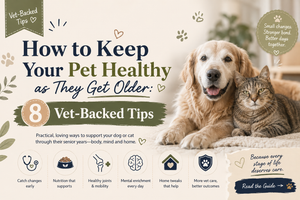
Keeping a pet healthy as they age comes down to a handful of consistent habits: catching changes early, adjusting food and exercise to match their new pace, supporting their joints, keeping their mind engaged, and seeing the vet more often than you did when they were young. None of this requires a dramatic overhaul, just steady small adjustments as your dog or cat moves into their senior years, generally around age 7 for most dogs and a little later for cats, though it varies by size and breed.
In this article
- What are the early signs of aging in pets?
- How often should senior pets see the vet?
- Does my pet need a different diet as they age?
- How can I support their joints and mobility?
- Why does mental enrichment matter for older pets?
- What home changes help an aging pet?
- FAQ
What are the early signs of aging in pets?
Ageing is usually gradual, so it helps to know what to watch for. Common early signs include slower movement or stiffness after resting, greying fur around the muzzle, weight gain or loss, cloudier eyes, more frequent naps, and changes in appetite or thirst. None of these are alarming on their own, but noticing them early means you can adjust care before a small change becomes a bigger problem.
How often should senior pets see the vet?
Most vets recommend moving from annual to twice-yearly check-ups once a pet reaches their senior years. Dogs and cats age faster than humans, so a lot can change in six months. Regular bloodwork and check-ups help catch conditions like arthritis, dental disease, kidney issues, or thyroid changes while they are still easy to manage, rather than after they have already affected quality of life.
Does my pet need a different diet as they age?
Often, yes. Older pets typically burn fewer calories, so the same portions that kept them lean at five years old can lead to weight gain at ten, and extra weight puts more strain on ageing joints and organs. Many senior-specific foods are formulated with adjusted protein and calorie levels along with added support for joints and digestion. Your vet is the best judge of what fits your pet's specific health picture, so it is worth asking at their next visit.
How can I support their joints and mobility?
Joint stiffness is one of the most common effects of ageing, especially in larger dogs. Keeping your pet at a healthy weight is the single biggest thing you can do, since every extra kilogram adds load to already-sensitive joints. Beyond that, shorter and more frequent walks tend to work better than one long outing, and softer surfaces are gentler than concrete. Feeding from a slightly elevated bowl can also make mealtimes more comfortable for a pet that finds bending down to a low dish increasingly stiff or uncomfortable.

Why does mental enrichment matter for older pets?
Cognitive decline is a real part of ageing for both dogs and cats, and mental stimulation appears to help delay it, much as it does in people. Puzzle feeders, gentle training refreshers, and simple scent games keep an older pet's brain engaged without demanding the physical effort a young pet might handle. A slow feeder or treat puzzle is an easy way to fold enrichment into a meal your pet already eats every day.
What home changes help an aging pet?
Small environmental tweaks can make daily life noticeably easier. A few worth considering:
- Keep food, water, and a cosy bed on one level if stairs have become difficult.
- Add non-slip mats on smooth flooring, since ageing joints and slippery tiles do not mix well.
- Raise food and water bowls slightly so your pet does not have to lower their head as far to eat and drink.
- Keep their bed away from draughts and away from direct heat, since older pets regulate temperature less efficiently.

A gentle incline that reduces how far your pet has to bend, making daily meals more comfortable as joints stiffen with age.

Turns an ordinary meal into gentle mental enrichment, slowing down eating and giving an ageing brain a little daily workout.
Frequently Asked Questions
A. At what age is a dog or cat considered a senior?
It varies by size. Small dogs are often considered senior around 10 to 12 years old, larger breeds closer to 6 to 8, and most cats around 10 to 12 years old, though individual health matters more than age alone.
B. How often should senior pets see the vet?
Twice a year is the general recommendation for healthy senior pets, with more frequent visits if your vet is monitoring an existing condition.
C. What are the first signs my pet is aging?
Slower movement, more sleeping, greying fur, cloudier eyes, and gradual weight changes are usually the earliest and most visible signs.
D. Do senior pets really need different food?
Many benefit from it, since calorie needs typically drop while the need for joint and digestive support goes up. A vet can confirm what best matches your pet's specific health.
E. What is the easiest way to help my pet's joints at home?
Maintaining a healthy weight has the biggest impact, alongside shorter and more frequent walks, non-slip flooring, and a slightly raised bowl to ease strain on the neck and shoulders.
Small comforts make the golden years easier
From joint-friendly feeding to mind-engaging enrichment, Wild & Waggle has gentle everyday gear for aging dogs and cats.
Shop Wild & Waggle →Free shipping on every order.