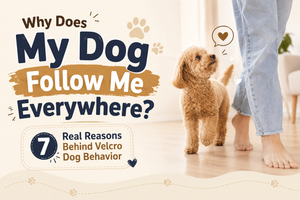
If your dog trails you from room to room, waits outside the bathroom door, and repositions itself every time you get up, you have what vets and trainers call a "Velcro dog." In most cases this is simply strong bonding: your dog sees you as its safe base, its source of food and affection, and its most reliable source of fun. Puppies can also imprint on their owner the way they would a mother, treats and attention can accidentally reinforce the habit, and in a smaller number of cases constant following can signal boredom, anxiety, or a health change worth mentioning to your vet.
In this article
- Is it normal for a dog to follow you everywhere?
- Why does my puppy follow me around the house?
- Am I accidentally training this behaviour?
- Is my dog bored, curious, or anxious?
- Do some breeds follow more than others?
- How to make being a shadow work for both of you
- FAQ
Is it normal for a dog to follow you everywhere?
Yes, and for most dogs it is actually a compliment. Dogs are a social species that evolved alongside us, and they naturally look to their owner as the centre of their world. When a dog is near you, its body releases oxytocin, the same bonding hormone involved in human attachment. Being close to you can also feel safer to your dog, especially in a new home or an unfamiliar environment like many apartments here in Singapore. If your dog is happy, eating well, and simply enjoys tagging along, there is usually nothing to fix.
Why does my puppy follow me around the house?
Puppies under about six months old often imprint on their owner much the way they would imprint on their mother. You feed them, comfort them, and teach them how the world works, so it is instinctive for a young puppy to stay within sight of you. This phase is completely normal and tends to soften a little as your puppy matures and grows more confident being on its own for short periods.
Am I accidentally training this behaviour?
Possibly. If your dog gets a treat, a cuddle, or excited praise every time it follows you into the kitchen or the bathroom, it learns that following pays off. This is not a bad thing on its own, but it is worth noticing, especially if you would rather your dog settle on its own bed sometimes rather than trail you constantly.
Is my dog bored, curious, or anxious?
Dogs are naturally nosy. If daily life is not mentally stimulating enough, following you becomes the most interesting thing on offer, since you are the "gateway" to walks, meals, and play. In other cases, following can point to generalised anxiety or separation-related distress, particularly if your dog also paces, whines, or seems unsettled when you are briefly out of sight, even in another room. A short chat with your vet is worthwhile if the clinginess appeared suddenly, especially in an older dog, since pain or a change in hearing or vision can also drive dogs to stick closer to their person.

Do some breeds follow more than others?
Yes. Breeds developed to work closely alongside people, such as herding breeds, retrievers, and many companion breeds popular in Singapore homes, tend to be more "velcro" than breeds bred to work independently, such as many terriers and guardian breeds. Individual personality still matters more than breed alone, so two dogs of the same breed can behave quite differently.
How to make being a shadow work for both of you
You do not need to discourage a loving dog from wanting to be near you. A few small habits help everyone stay comfortable:
- Give your dog a job when you cannot have them underfoot, such as a slow feeder or a foraging puzzle that keeps them settled and mentally occupied.
- Practise short, low-key separations at home so being briefly alone stays normal and low-stress.
- When you genuinely want your dog along, bring them along properly and safely rather than fighting the instinct.
- Reward calm, settled behaviour on their own bed, not just behaviour that keeps them glued to your side.

Keep your shadow close on errands and commutes, hands free, so following you can actually mean going with you.

A snuffle-and-forage toy that gives a curious or anxious dog something absorbing to do while you step away.
Frequently Asked Questions
A. Is it normal for my dog to follow me to the bathroom?
Yes, this is one of the most common versions of velcro dog behaviour. Your dog cannot see or smell you through a closed door, so waiting right outside is simply the easiest way to stay close to their person.
B. Which dog breeds are known for being "velcro dogs"?
Breeds bred to work closely with people, including many herding and retrieving breeds and popular companion breeds, tend to be the clingiest. That said, following behaviour comes down to the individual dog as much as the breed.
C. How do I get my dog to stop being so clingy?
Build up short, calm separations gradually, reward your dog for settling on their own bed, and make sure they are getting enough physical and mental exercise so following you is not their only source of stimulation.
D. Should I worry if my older dog suddenly starts following me everywhere?
A sudden change is worth mentioning to your vet, particularly in senior dogs. New clinginess can be linked to pain, vision or hearing loss, or cognitive changes, rather than a simple increase in affection.
E. Is following me a sign of separation anxiety?
It can be, but only when it comes with other signs such as pacing, whining, drooling, or destructive behaviour whenever you are out of sight, even briefly. Following alone, without distress, is usually just closeness, not anxiety.
Make it easy to bring your shadow along
From hands-free carriers to car seat beds, Wild & Waggle has the gear for dogs who would rather be wherever you are.
Shop Wild & Waggle →Free shipping on every order.